
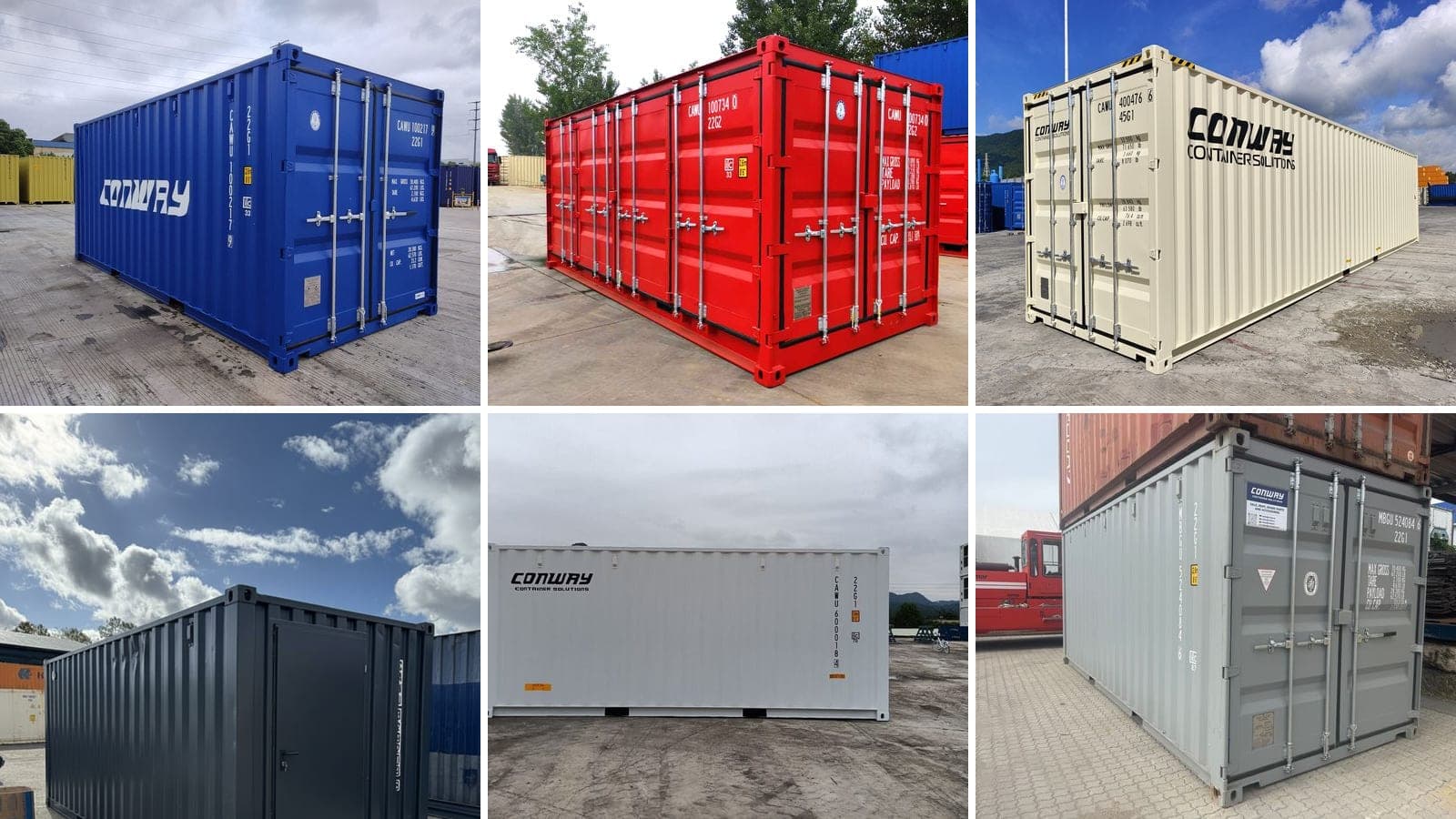
In a port, shipping containers form a colourful wall: blue, red, orange, green, grey and white. Does the colour mean anything, and which one should you choose? This article explains in plain words what colours shipping containers come in, why they differ so much, which RAL shades are the most common and how to choose a colour for a storage container, container home or site office in Vilnius, Klaipėda and across Lithuania.
Does the colour of a shipping container matter?
International ISO standards set a container's dimensions, strength and markings - but not its colour. The colour is chosen by the owner: a shipping line, a container lessor or the buyer. So the colour tells you nothing about the type, condition or quality of a container: a blue box is no better than a red one. Quality depends on condition - new (one-trip), cargo worthy (CW) or wind and watertight (WWT).
Why shipping containers come in different colours
- Brand and recognition. Major shipping lines paint their containers in corporate colours and add their logo, so in a port or terminal it is clear at a glance who owns a box.
- Corrosion protection. A container is made of steel, and at sea it faces salt, moisture and temperature swings. The coating has several layers - a zinc-rich primer, an intermediate coat and a topcoat. The paint is what keeps the steel from rusting, so it is protection as much as looks.
- Temperature. A light surface heats up less in the sun than a dark one. That is why reefer containers are almost always white: the light colour reflects sunlight, so the refrigeration unit has to work less.
- New owner, new colour. When a container retires from shipping service, it is sold. The new owner often paints over the logos or repaints the whole box in their own colour.
Common shipping container colours and RAL codes
A container colour is usually specified with a RAL code - four digits from the colour system widely used in Europe. The table shows the shades you see most often on shipping containers.
| Colour | RAL code | Name | Where you often see it |
|---|---|---|---|
| RAL 7035 | Light grey | New containers, storage and site office containers; heats up less in the sun. | |
| RAL 7016 | Anthracite grey | Container homes, offices and saunas; a modern, understated shade. | |
| RAL 9005 | Jet black | Design projects, cafés and shops; heats up the most in the sun. | |
| RAL 5010 | Gentian blue | One of the most popular shades for new containers in Europe. | |
| RAL 5013 | Cobalt blue | A dark blue for new containers; shows dirt less. | |
| RAL 3020 | Traffic red | Bright and eye-catching; building sites and retail spots. | |
| RAL 3009 | Oxide red | The classic red-brown shade, often seen on used containers. | |
| RAL 6005 | Moss green | Dark green; gardens, country plots and forest areas. | |
| RAL 6011 | Reseda green | A lighter, calm green; for gardens and summer houses. | |
| RAL 1015 | Light ivory | Beige, warm and light; heats up less in the sun. | |
| RAL 2004 | Pure orange | Very bright; visible from afar and catches the eye. | |
| RAL 9010 | Pure white | White containers and light-coloured projects; reflects sunlight. |
The first digit of a RAL code gives the colour group: 1 - yellows, 2 - oranges, 3 - reds, 4 - violets, 5 - blues, 6 - greens, 7 - greys, 8 - browns, 9 - whites and blacks. On-screen colour samples are approximate and depend on your display settings. If the exact shade matters, compare it with a physical RAL colour chart.
Shipping line colours
Many shipping lines have a colour of their own, so you can often recognise a container from a distance:
| Shipping line | Typical container colour |
|---|---|
| Maersk | light blue with a white seven-pointed star |
| Hapag-Lloyd | orange |
| Evergreen | green |
| ONE (Ocean Network Express) | bright pink (magenta) |
| CMA CGM | mostly blue |
| Hamburg Süd (now part of Maersk) | red |
| Container lessors | neutral shades: grey, beige, red-brown |
Still, colour is only a hint. Containers are bought, sold and rented out, so they often change hands. The owner is identified exactly by the container number on the doors (ISO 6346): four letters and seven digits - for example, MSKU is Maersk and HLXU is Hapag-Lloyd.
New and used containers: which colours can you buy?
New (one-trip) containers are painted at the factory in the colour the customer orders. In Europe, popular choices are grey, blue, green and anthracite, such as RAL 7035, RAL 5010, RAL 6005 or RAL 7016. A new container has an even finish with no scratches or traces of old logos.
Used containers usually keep their previous owner's colour. Expect faded paint, scratches, patches in a slightly different shade (for example, where a logo was painted over) and small spots of surface rust. This is normal and does not affect the container's strength - what matters is its technical condition.
The colour of every available unit is listed in Containers in stock.
A used container can also be repainted: the surface is cleaned, rust is removed, then primer and a paint made for metal are applied. Container homes and offices are usually painted outside in a chosen RAL shade - for example, Conway living containers come in anthracite RAL 7016 as standard and can be painted in any other colour on request.
How to choose a container colour
- For storage - light shades (RAL 7035, RAL 9010, RAL 1015). They heat up less in the sun, so it stays cooler inside.
- For a home, office or sauna - anthracite (RAL 7016), black (RAL 9005) or dark green (RAL 6005). They look modern but get hotter in the sun, so good insulation and ventilation matter.
- For a garden, country plot or forest edge - greens and browns (RAL 6005, RAL 6011, RAL 3009) that blend into nature.
- For a café, shop or event - your brand colour or a bright shade (RAL 3020, RAL 2004, RAL 5010) that catches the eye. See also commercial container spaces.
- For long-term placement - if the container will stay in one place for a long time, ask your local municipality whether the area has rules on building colours.
Frequently asked questions
Does the colour affect the price of a container?
Usually not. The price depends on size, condition, quantity and delivery location. A non-standard colour or a repaint is extra work, so its cost is calculated separately.
What colour are reefer containers?
Almost always white or very light. A light surface reflects sunlight, so the container heats up less and the refrigeration unit uses less energy. See the available models in Reefer containers.
Can you tell who owns a container by its colour?
Often yes, because shipping lines use their own colours. But only the container number on the doors tells you for sure - its first four letters are the owner code.
Can a used shipping container be repainted?
Yes. Preparation is key: clean the surface, remove rust, apply primer and only then an exterior paint made for metal. A well-prepared coating will last a long time.
Which colour heats up least in the sun?
White and other light shades such as RAL 9010, RAL 7035 and RAL 1015. Dark shades - anthracite and black - heat up the most.
Looking to buy a shipping container in a particular colour? Browse new containers, used containers or containers in stock, where the colour is listed for each unit - or write to us and we will help you find the right one, with delivery across Lithuania and the Baltics.