
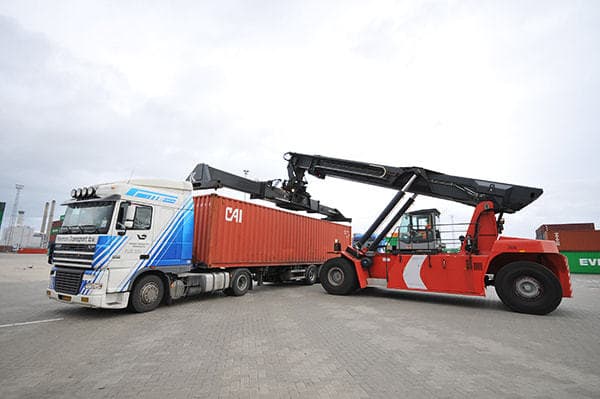
A well-prepared site is half of a successful container purchase. On uneven ground the doors start to stick, water gathers underneath, and on delivery day the truck may simply not get in. This article explains how to prepare the ground for a shipping container and what to expect at delivery.
Why the base matters
A shipping container rests on four corner castings. If one corner sits lower, the body twists slightly and the doors no longer close tightly. A container standing directly on earth or grass also stays damp underneath and rusts sooner. So the base must be level, firm and raised at least a few centimetres.
Types of base
- Compacted gravel or crushed stone pad - the simplest option for storage; it must be level and well drained.
- Concrete blocks or slabs under the corners - the most common choice: the container is raised and air flows underneath.
- Piles - for soft or uneven ground, and for living modules.
- Concrete slab or asphalt - for company yards where containers stand long and machinery drives often.
A 20ft container usually only needs supports under its four corners; for a longer 40ft container it is worth adding supports in the middle too.
Level and height
Before delivery, check the supports with a spirit level or a laser level - the difference between corners should be as small as possible. Leave a gap under the container so rainwater doesn't collect, and decide which way the doors will face - you need space in front of them.
Access and room for delivery
We deliver with a crane truck or a side loader:
- Small crane truck (10-20ft): 6-7.5 m platform, 10-15 t capacity, 9-12 m reach, unloading at the front or side.
- Large crane truck (40-45ft): 12-13.7 m platform, 17-21 t capacity, 12-14 m reach.
- Side loader: a semi-trailer with two hydraulic lifts, up to 32 t; it sets the container down parallel, about 1 m from the vehicle - handy where space is tight.
The truck needs a firm road to the spot, enough turning room and space for the crane's stabilisers. Watch out for overhead power lines, low branches, soft lawn and wells or underground pipes that heavy machinery must not stand on.
Checklist before delivery
- The base is level and firm, the supports are in place.
- The truck can drive in and turn.
- No wires or low branches above the spot.
- You know which way the doors should face.
- Someone will be on site on delivery day to show the spot.
Not sure the truck will fit? Send us photos of the site and we will choose the right vehicle.
Stacking containers
Shipping containers can be stacked and locked together through their corner castings with twist locks. Twist locks and other fittings are in our Spare parts and accessories section.
For living modules
For a living container the base is especially important: level, raised and ready for utilities - power, water and drainage. Piles or concrete blocks are used most often. See Container homes in Lithuania.
Do you need a permit?
It depends on the container's use, size and location, and the rules are set by the municipality (savivaldybė). Before placing a container for a longer period, ask your municipality's administration.
More on delivery under Transport services. To choose the container size, read Shipping container dimensions.