
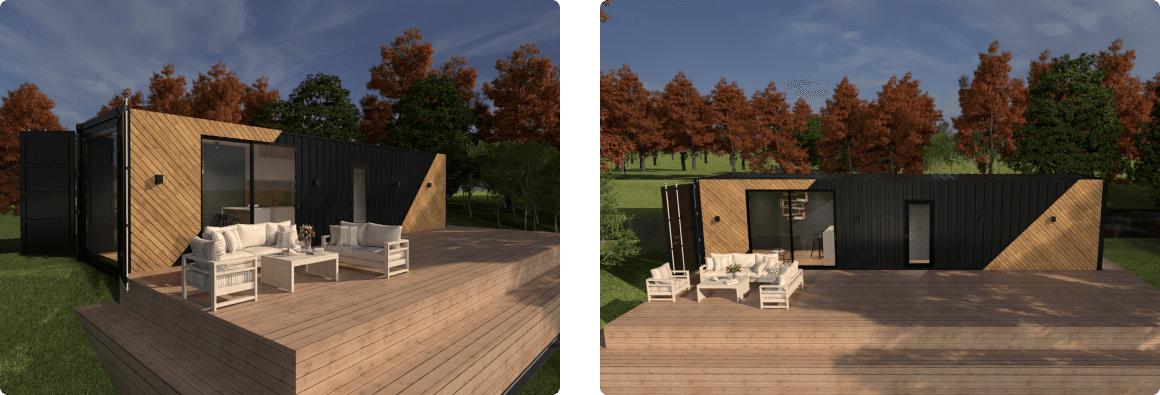
Container homes are increasingly popular in Lithuania: homestead owners choose them as guest houses, holiday cabins by a lake or staff accommodation. Such a house goes up quickly, needs no complex foundation and can be moved if needed. Here is what to know before you buy.
A living container is not a site cabin
In Lithuania the word "living container" is often also used for building-site cabins, which are usually made of lightweight sandwich panels. The container home described here is made from a steel shipping container - strong, resistant to wind and snow, and built to be lifted by crane and transported. Conway's living containers are made from new 20 and 40 ft High Cube shipping containers.
What a living container includes
- walls and ceiling insulated with closed-cell PU foam (50-70 mm), Kingspan Therma TF70 boards under the floor;
- laminated MDF finish and heavy-duty vinyl flooring;
- PVC windows and doors, an interior door;
- a bathroom with toilet, washbasin, shower cabin and 80-litre water heater;
- concealed wiring, distribution board, LED lighting and an outdoor 16 A plug;
- a 3.5 kW air conditioner with heat pump and heat-recovery ventilation;
- outside paint in RAL 7016 (anthracite grey) or another colour of your choice.
The full list is on the Container homes page.
How much space you get
| 20ft High Cube | 40ft High Cube | |
|---|---|---|
| External size | 6.06 × 2.44 × 2.9 m | 12.19 × 2.44 × 2.9 m |
| Floor area before finishing | about 13.9 m² | about 28.3 m² |
| Inside height before finishing | 2.7 m | 2.7 m |
Insulation and finishing take a little width and height. A 20ft module suits one or two people, a 40ft module everyday living. For a larger house, join two or more modules.
What a container home is good for
- a guest house or holiday cabin on a homestead;
- staff accommodation next to a site or a farm;
- temporary housing while the main house is being built;
- a rental cabin for tourists;
- an office or workshop with facilities.
Foundation and site
A shipping container rests on its four corners, so it needs no continuous foundation. Concrete blocks or piles under the corners are usually enough - what matters is level, firm support and a little clearance above the ground. There must also be room for a crane truck to reach the spot and set the module down. More in How to prepare the ground for a shipping container.
Utilities
The module arrives with concealed wiring and with water and drainage pipework. On site it is connected to power, water and drainage - for example mains, a well or a local wastewater system. Think about this when choosing the spot on your plot.
Permits: ask your municipality
Whether a container home needs a permit depends on its use, size, the plot and its location, and the rules are set by the municipality (savivaldybė). Before buying, ask your municipality's administration whether a permit or another document is needed and what applies to your plot. We do not give legal advice, but we are glad to supply the module's dimensions and technical data you may need.
Pros and cons
Pros: built in advance and delivered finished; light foundations; can be moved; a strong steel frame; modules are easy to join.
Things to consider: the inside width before finishing is about 2.35 m, so plan the layout; one module has limited space; steel walls need good insulation or condensation forms; sort out the permit question in advance.
How much does a container home cost?
The price depends on the size and number of modules, layout, finish, equipment and delivery address, so each project gets its own quote. To make it accurate, tell us what the house is for, how many people will live there, which module size you want and where it will stand.
Common questions
Can you live in a container home in winter? Our living containers are insulated with closed-cell PU foam and Kingspan Therma TF70 floor boards, and a 3.5 kW air conditioner with heat pump plus heat-recovery ventilation handles heating and cooling - they are built for living in.
Can several containers be joined into one house? Yes. Two or more modules can be combined into one larger house - the usual way to get more space for a family.
What colours are possible? The standard exterior colour is RAL 7016 (anthracite grey), but another colour can be chosen. Container colours and RAL codes are explained in Shipping container colours.
Can the house be moved later? Yes. The module is portable - it can be lifted by crane and taken to another site, as long as a base is prepared there too.
Why is a new container better than a used one for a home? A new High Cube has unworn steel and paint and is taller, so more headroom remains after finishing. A used container is ideal for storage.
How to order
- Get in touch via the form, on +370 650 61953 or at sales@cway.lt.
- Together we choose the size, layout, finish and colour.
- Once you approve the offer, we build the module.
- We deliver and set it up on your plot anywhere in Lithuania.
Other container buildings - offices, cafés and pools - are under Container homes and buildings.